
Table of contents
When I look at a new niche, one of the first things I check is whether the profession has its own association. It is one of the nine checks I describe in how to find a niche job board idea. And where there is an association, there is almost always an association job board, usually called the career center.
Many founders stop there. They assume the association owns the audience, and that nobody can compete with the body that hands out the certification. I read it the other way round. An association job board proves that employers in this profession pay to post jobs. And it is usually a competitor you can beat on the product, because it was never designed to be one.
Here is what I see when I study these boards, and what we do differently across the Rolework network.
You have to be a member
An association job board is a member benefit, and the membership shows up everywhere. Candidates often have to log in as members to read the full listing or to apply. Employers nearly always pay one price as members and a higher one as non-members. On two large association career centers I looked at in November 2026, a single 30-day posting cost $250 to $305 for members and $350 to $480 for everyone else.
The trouble is that members are only part of a profession. Students, career changers, people working abroad and anyone whose employer stopped paying the dues are outside the gate. So are small employers who hire once a year and will not join an association to do it. MemberClicks, which sells software to associations, tells the story of one that removed the paywall from its job board and saw the board's reach grow fivefold.
A niche board has no gate. Every job is public, readable without an account and open to Google.
The site is often dated
Many career centers run on a platform chosen years ago and bolted onto the association's website. You recognise them quickly: a design that has not moved in a decade, pages that are hard to read on a phone, a search that returns a handful of results. The vendors say so themselves. A vice president at Naylor, one of the large suppliers, wrote in 2025 that these career centers are often "buried three clicks deep on a website, rarely promoted, and disconnected from the rest of the members' experience."
Candidates compare every job site with LinkedIn and Indeed. A board that is fast, readable on a phone and updated every day already wins that comparison.
It was not designed as a job board
This is the main point. For an association, the job board is one line in a list of benefits, after the conference, the journal and the certification. In member research quoted by Web Scribble, another career center vendor, 46% of members put access to job opportunities among their top priorities. Only 14% of association staff saw it as a key reason people join.
The result is a product that lacks what a job board needs:
- No backfilling. The only jobs on the site are the ones an employer paid to post, so a profession of 50,000 people can show twenty openings. Candidates look once and do not return. We backfill every board, so candidates see the whole market and not only the paid part of it. Kardow's job backfiller does this on a schedule, from careers pages and job feeds, filtered to your niche.
- No ATS connection. Recruiters publish jobs in their applicant tracking system and expect them to flow out from there. On many association boards they still fill in a form for every job. A board that reads the employer's feed, and sends candidates to the employer's own application page, asks nothing more of the recruiter.
- Little search visibility. Job pages need structured data to appear in Google for Jobs, and a board needs a page for every location and category. Job board software does this by default.
One profession, several associations
An association serves its members, usually in one country. A profession rarely stops there. Rope access technicians hold an IRATA or a SPRAT certification, sometimes both. Optics engineers join SPIE or Optica. Health and safety has IOSH in the UK and ASSP in the US. Each body speaks to its own members, and its job board carries its own fraction of the jobs. A niche board covers the whole profession in one place, whoever issued the certificate.
These are some of the boards we built in professions that already had strong associations:
| Board | Jobs covered | Bodies candidates identify with |
|---|---|---|
| acousticsjobs.com | Acoustic engineering, noise control and vibration | Institute of Acoustics, Acoustical Society of America |
| econ-jobs.com | Economists and applied economics | American Economic Association, Royal Economic Society |
| ohscareers.com | Occupational health and safety | IOSH, ASSP |
| ropeaccesscareers.com | Rope access technicians | IRATA, SPRAT |
| photoncareers.com | Optics, photonics and lasers | SPIE, Optica |
| businessschoolcareers.com | Business school faculty, research and administration | AACSB, EFMD |
| heorcareers.com | HEOR, market access and real-world evidence | ISPOR |
| investorrelationscareers.com | Investor relations and financial communications | NIRI, IR Society |
| corporatetreasuryjobs.com | Corporate treasury, cash and liquidity management | ACT, AFP |
| geologicalcareers.com | Geoscience, mining and environmental | Geological Society of America, Geological Society of London |
| aquaculturecareers.com | Aquaculture, fish health and hatchery | World Aquaculture Society, European Aquaculture Society |
Work with the association, not against it
None of this makes the association an enemy. It defines the profession, and I use it at every step. Its membership tells me how many people do the job. Its conference calendar tells me when to promote the board. Its certifications become filters on the board. It is also worth a conversation: an association with a tired career center may prefer a partner to a rebuild.
What I would not do is wait for permission. Check that the niche is worth building, pick a domain the profession will recognise, and launch with the backfill on so the board is full on the first day. The association keeps the conference and the certification. You become the place where the profession finds its jobs.
Launch a board that is full on day one.
Jobs imported from careers pages and feeds, Google for Jobs markup on every listing, and 0% of your job sales. 14-day free trial.
14-day free trial. No setup fee.
Keep reading
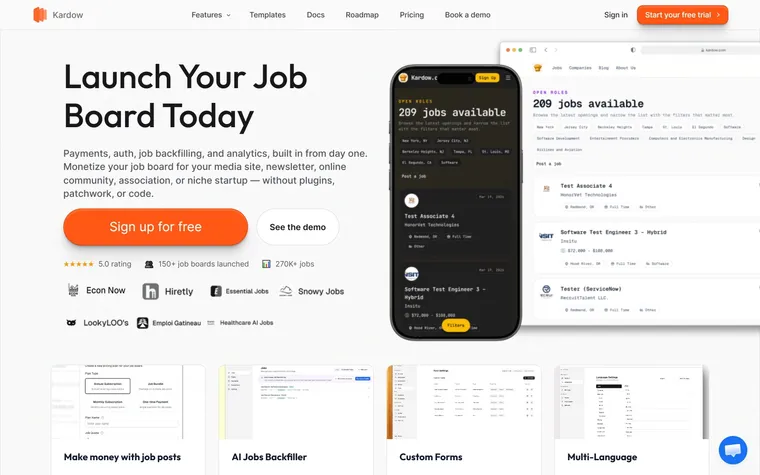
Launch your job board today
Payments, sign-in, job backfilling and analytics are built in from day one.
- Live in under 10 minutes
- 14-day free trial on every plan
- No setup fee, 0% platform fee